Wyndham Clark Wins the 2026 US Open at Shinnecock Hills

A six-shot lead, a hostile gallery, and one of the more gripping Sunday finishes in recent major championship history.

The 126th US Open, played at Shinnecock Hills Golf Club in Southampton, New York, was always going to produce a story. Shinnecock has that effect. It punishes complacency, rewards the scrambler, and creates theatre on the final day. This year was no exception.

Wire to Wire — and Every Inch of It

Wyndham Clark entered Sunday’s final round six strokes clear. He shot a 73. He still won by one. That tells you more about Shinnecock Hills than it does about the champion.

Wyndham Clark with the US Open trophy at Shinnecock Hills Golf Club, Southampton, June 2026

Clark’s decisive quality all week was scrambling — 16 of 24 saves over four rounds. The most important came on the par-5 16th, when he drove into thick fescue, escaped, and holed a 25-foot birdie to re-establish a two-stroke lead. A three-putt bogey on the 17th reduced it to one. Two putts from 52 feet on the 72nd hole sealed it. Final score: 4-under 276, one ahead of Sam Burns. Clark became the ninth player in US Open history to go wire-to-wire — joining a list that includes Tiger Woods and Rory McIlroy.

The Crowd and the Redemption

This win carries weight beyond the leaderboard. Clark had a difficult 2025, a season that included a well-documented incident at Oakmont and considerable reputation repair. He arrived at Shinnecock with a portion of the gallery openly against him — many rooting instead for Scottie Scheffler, world number one, chasing the career Grand Slam on his 30th birthday and Father’s Day. Clark handled the noise with composure. “Anytime someone said something negative to me, I replaced it with something positive,” he said. His father, Randall, having taken a red-eye from Denver to surprise his son on Sunday morning, was waiting by the 18th green. It was that kind of afternoon.

The Chasers

Sam Burns had the round of the day — a 67 — and came within a stroke of a playoff. He birdied four of his first eight holes in a charge that, at one point, appeared capable of overturning a seven-shot deficit.

Sam Burns in action during his final-round 67 at the 2026 US Open, Shinnecock Hills

Missed putts on both the 17th and 18th holes ended the run. It was his third consecutive top-ten finish at a US Open.

Scheffler finished tied fourth at even-par 280. The career Grand Slam remains unfinished business.

Scottie Scheffler on the course the final round, Father's Day, Shinnecock Hills

McIlroy, briefly in contention on Saturday, described the final day as the course “winning the battle.” Tom Kim, ranked 141st in the world and playing as a qualifier, finished a composed solo third at one-under — and earned his exemption into next year’s US Open at Pebble Beach.

What Shinnecock Demands

Shinnecock Hills rewarded one quality above all others this week: the ability to hold a game together when the course is actively working against you. Fescue rough that punishes the wayward shot. Greens fast enough to produce three-putts from anywhere. A wind that changes the arithmetic every hour. Clark’s answer to all of it was definitive.

If Sunday’s final round has put golf firmly back on the agenda — it tends to do that — there are courses rather more welcoming than Shinnecock’s fescue waiting across the Atlantic. Browse our Portugal golf holidays and play in the sunshine, where scrambling is entirely optional.

Welcome to the Ferragudo Golf Course

A New Algarve Parkland course with Character, History and Strategic Variety.

At Tee Times Golf Holidays, we recently had the opportunity to visit Ferragudo Golf Course and experience the layout firsthand ahead of its official opening. Walking the course gave us valuable insight into its design, character, and playing experience, reinforcing our belief that it will become a popular addition to the Algarve golf scene.

Now that Ferragudo Golf Course is officially open, golfers can book tee times and golf holiday packages through Tee Times Golf Holidays, with access to the latest availability and our local expertise to help plan their visit.

________________________________________________________________________________________

The Algarve’s reputation as one of Europe’s premier golf destinations continues to grow, and the arrival of Ferragudo Golf Course adds another compelling chapter to that story. Located in the Portimão area and developed under the umbrella of the Pestana Group, Portugal’s largest hotel and tourism operator, this new parkland layout introduces a refreshing blend of natural integration, strategic design, and historical character.

Ferragudo Golf Course tee-off and fairway

Rather than relying on dramatic elevation changes or heavy water usage, Ferragudo places its emphasis on routing, angles, and shot selection. The course is set comfortably within the Algarve landscape, where mature vegetation and natural contours frame a layout that feels both modern and timeless.

A Par-73 with Flexible Yardages

Ferragudo plays as a Par 73 and offers multiple teeing options to suit a wide range of golfers:

  • White Tees: 5,841 metres
  • Yellow Tees: 5,227 metres
  • Red Tees: 4,594 metres

This flexibility ensures the course can be enjoyed both as a championship test and as a more accessible resort-style round.

A Course Defined by Variety

One of Ferragudo’s defining strengths is the sheer variety of its holes. The routing avoids repetition, instead offering a sequence of short and long holes that demand constant adjustment in strategy. Players are required to think carefully about positioning, especially on approach shots where angles into greens are often more important than raw distance.

Ferragudo Golf - a course with variety

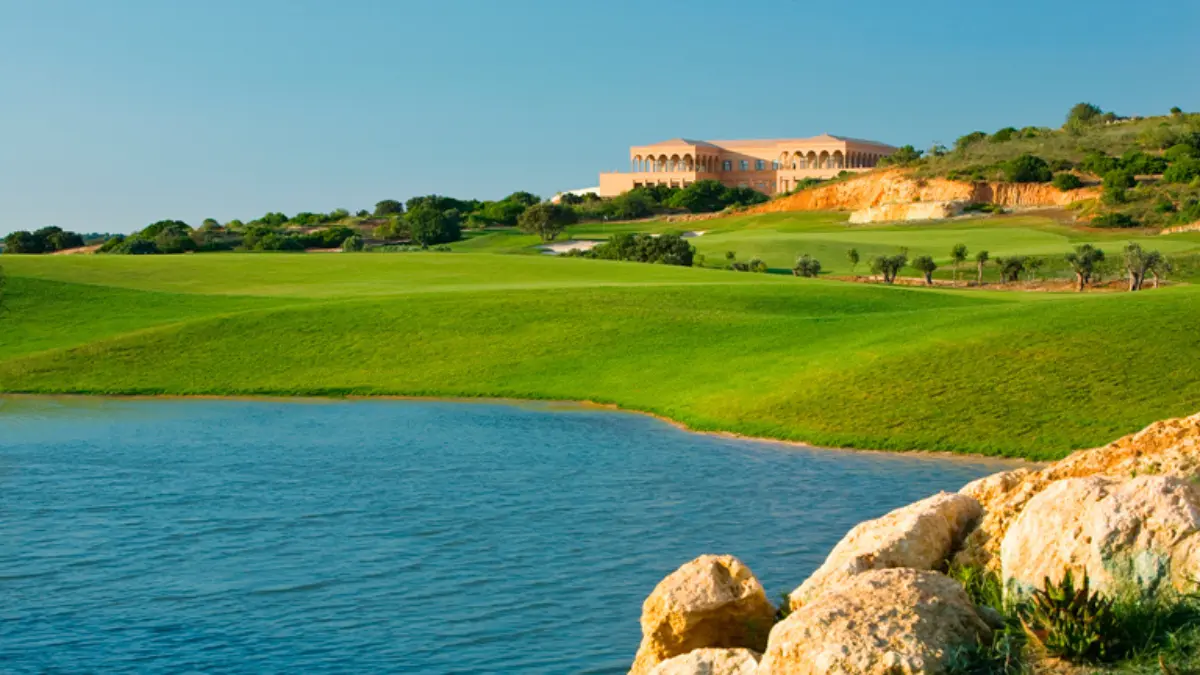
Water is notably scarce throughout the round, used sparingly to maximum effect. In fact, it only comes into play on the closing hole — the Par 5 18th (Stroke Index 6) — where a lake guards the approach to the green, providing a dramatic finishing risk-reward decision.

History Embedded in the Landscape

Perhaps the most distinctive visual and architectural feature of Ferragudo Golf Course is its integration of historic ruins across the property. These remnants of the past are not merely decorative; they form part of the course identity and visual rhythm.

Ferragudo Golf Tee and Chapel ruins

The most striking of these is an old chapel positioned at a natural crossroads of the layout, influencing play on holes 9, 10, 12, and 13. Plans have been suggested to restore this structure and repurpose it as a halfway house — a unique feature that could become one of the most memorable stopping points in Portuguese golf.

A Parkland Built for Shot-Making

Ferragudo is not a course that overwhelms with brute difficulty, but rather one that rewards thoughtful execution. The absence of heavy water hazards places greater emphasis on fairway positioning, controlled iron play, and creativity around the greens.

Ferragudo Golf Parkland Couse

The result is a layout that promises variety, rhythm, and constant decision-making — a course where no two holes feel the same, and where scoring depends as much on imagination as on power.

Final Impression

With its thoughtful routing, historic atmosphere, and strong integration into the Algarve landscape, Ferragudo Golf Course is positioned to become a notable addition to the region’s already impressive golfing portfolio.

It is a course that invites repeated play, not because it is overwhelming, but because it reveals itself differently with each round.

Ferragudo is not just another Algarve golf course — it is a new identity shaped by land, history, and design intelligence.

Ferragudo Golf Course is a welcome addition to an already strong Algarve portfolio — and reason enough to start planning a visit. Browse our Algarve golf holidays and see what the region has waiting for you.


Vote for Tee Times

June and July Golf in the Algarve: A Golfing Secret

The crowds have gone. The mornings and evenings have not.

The Algarve’s peak golf season belongs to spring — April and May bring mild temperatures, green fairways, and full tee sheets. What follows in June and July is a different proposition entirely. Fewer golfers. Longer days. A pace that feels closer to what the region actually is, rather than what the calendar tells most visitors to expect.

The Early Tee Time Is Your Friend

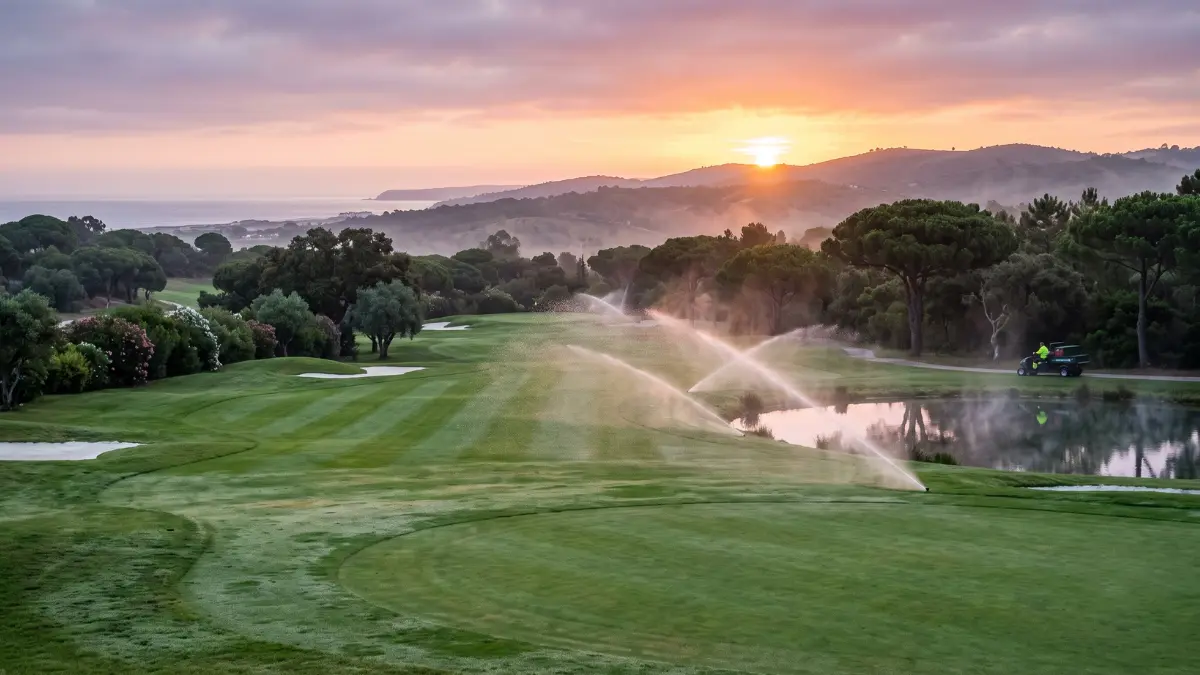
The Algarve coastline bathed in evening light during summer, Portugal
Summer in the Algarve means sunrise before 6:30am. An early tee time — 7am, or earlier at some courses — puts you on the fairway in conditions the midday golfer never sees. The light in those first hours is something particular: low and warm across the fairways, with a stillness to the air that belongs entirely to early morning. The cork oaks hold the shadow a little longer. The dew is still on the rough. By the time the sun is fully overhead, the round is done and the terrace is waiting.

The Long Evening Is an Underrated Asset

The Algarve in late June sees the sun set at around 9:15pm (timeanddate.com). That is not a minor detail. It means a back nine after dinner without the feeling of racing the clock. It means the kind of long, golden-hour light that does things to a links-style layout that a noon round cannot replicate. The western Algarve, in particular — where the Atlantic horizon sits just beyond the last fairway — earns that final hour of daylight more than most places. Summer evenings here are not a consolation. They are the whole point.

Green Fees in Summer: A Different Equation

Palmares Golf Course overlooking Meia Praia bay and the Alvor estuary, Lagos, Algarve
Peak spring green fees at the region’s flagship courses can be significant. Summer rates — particularly in June, before the school holiday surge — offer considerably better value without a corresponding drop in course quality. The greens have been through a full season of careful preparation. The price is lower because demand is lower. That gap is wider than most golfers realise, and it is one of the better-kept secrets on the European golf travel calendar.

The Courses That Reward a Summer Visit

Not every course in the Algarve plays identically in summer. Layouts with Atlantic exposure — set above the western coastline, or at elevation — benefit from the prevailing coastal breeze throughout the morning hours. Palmares, rising above Lagos and the long sweep of Meia Praia bay, is one of those courses: the views across the Alvor estuary alone justify the drive west. Boavista — designed by Howard Swan and chronically underappreciated — sits on the same western stretch, its two distinct sections climbing and descending through landscaped valleys in a way that rewards patience and repeat visits. Further east, the umbrella pines of Vilamoura Old Course offer shade and quiet that the busier spring months rarely allow.

The Region in Summer

The Algarve coastline bathed in evening light during summer, Portugal
The Algarve does not slow down in summer so much as settle into itself. The limestone cliffs along the coast turn amber in the late afternoon light. The fishing boats sit low in Ferragudo harbour. The market stalls in Loulé carry the smell of fresh bread and dried herbs, and the restaurants fill gradually rather than all at once. Evenings stretch long enough to make dinner feel genuinely unhurried. A cold Sagres on a terrace facing west, with the light still in the sky at nine in the evening, is one of those small, specific pleasures that cannot really be argued with. Golf brings you here in June and July. The region is the reason you book again.

Browse our Algarve golf holidays and start planning your summer.


Vote for Tee Times