Tee Times Golf Holidays Nominated for Europe’s Best Golf Tour Operator 2026

Tee Times Golf Holidays has once again been nominated for the prestigious Europe’s Best Golf Tour Operator 2026 award at the World Golf Awards, one of the most respected and recognised accolades in the international golf tourism industry.

A Record of Recognition

This nomination marks another important milestone in a journey that has seen Tee Times establish itself as one of the leading names in golf travel. Over the years, the company has received multiple World Golf Awards distinctions, including Portugal’s Best Inbound Golf Tour Operator, Portugal’s Best Outbound Golf Tour Operator, and Europe’s Best Golf Tour Operator, reflecting its long-standing commitment to excellence and customer satisfaction.

From Vilamoura to the Wider World

Founded in Vilamoura in 1993, Tee Times Golf Holidays has grown alongside the Algarve’s rise as one of Europe’s premier golf destinations. What began as a small local business has evolved into an internationally recognised golf tour operator, helping thousands of golfers enjoy unforgettable golf experiences every year.

Portugal, Spain and Beyond

Today, Tee Times offers one of the most comprehensive golf holiday portfolios in the market, with programmes available throughout Portugal and Spain, from the Algarve, Lisbon and Porto to the Costa del Sol, Costa Blanca, Madrid, the Balearic Islands and the Canary Islands. In addition, the company has expanded its offering to include a selection of renowned international golf destinations, giving clients access to some of the finest golf courses and resorts around the world.

Built on Partnership and Trust

Over more than three decades, Tee Times has built strong relationships with golf courses, hotels and tourism partners, earning a reputation for expertise, reliability and exceptional service. The company currently handles around 120,000 rounds of golf annually, a reflection of both the scale of its operation and the trust placed in it by golfers worldwide.

The nomination for Europe’s Best Golf Tour Operator 2026 is a recognition not only of the work and dedication of the Tee Times team, but also of the confidence shown by the thousands of clients who choose the company to organise their golf holidays year after year.

How to Cast Your Vote

Voting for the World Golf Awards 2026 is now open and is available to both industry professionals and golf travellers.

If you have travelled with Tee Times Golf Holidays, booked a golf holiday through our team, or simply followed our journey over the years, we would be delighted to receive your support.

Vote for Tee Times Golf Holidays as Europe’s Best Golf Tour Operator 2026

👉 Vote here:

Vote for Tee Times Golf Holidays as Europe's Best Golf Tour Operator 2026 at the World Golf Awards

Every vote is a recognition of more than 30 years of dedication to golf tourism, the trust of our clients, and the strong partnerships we have built along the way. Your support can help us continue to strengthen Tee Times Golf Holidays’ position among Europe’s leading golf tour operators.

Thank you for your trust and support.

Should You Bring Your Own Clubs on a Golf Holiday? The Case For and Against

What frequent flyer perks, damage statistics, and one snapped driver shaft can teach you about packing for a Golfing Getaway.

Every serious golfer has had the debate at some point before a trip: pack the clubs, or hire on arrival. It sounds like a small decision. It rarely is. Get it wrong and it can mean an extra hour at the baggage carousel, a damaged driver, or simply irons that never quite feel like yours. Here is what actually weighs on each side of the argument.

The Case for Bringing Your Own Set

There is no substitute for clubs you know. Your own irons carry the exact lie angle, shaft flex and grip wear that your swing has adapted to over years, and no rental set — however well maintained — replicates that. For golfers with a single-digit handicap, or anyone who has recently been fitted, the performance gap between “mine” and “borrowed” is not trivial. It shows up in distance control and, more than anywhere, around the greens.


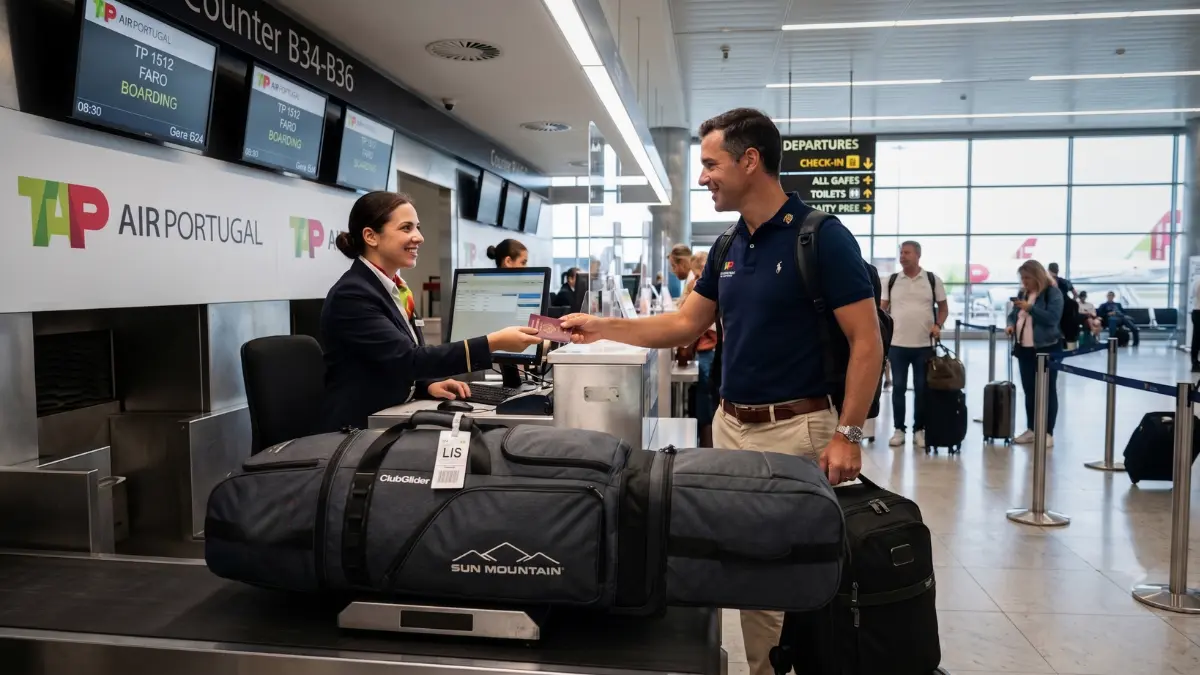
Golfer checking in a golf travel bag at airport departures before a golf holiday

What It Actually Costs to Fly With Them

The honest answer is: more than most golfers expect, and not just in euros. TAP Air Portugal treats golf bags as special sports baggage, with fees typically running from around €45 to over €100 depending on route and season, and registration required at least 24 hours before departure . Budget carriers popular for short Algarve or Costa del Sol hops are no kinder — easyJet charges roughly £15 per 3kg increment above a 20kg allowance, on top of its own booking fee for the bag itself . Add the return leg, and a couple travelling with two sets can be looking at well over €200 in fees alone before a single green fee is paid. (Baggage Policies) ; (Greencard Golf)

The Risk Nobody Budgets For

Then there is the handling itself. Industry travel-insurance data puts golf club damage at around 1.2% of checked-bag journeys — a figure that drops below 0.1% with a proper hard case, which says a great deal about how soft-sided bags fare in an aircraft hold . Delayed or misrouted bags are a separate headache entirely: airlines classify a bag as officially lost only after searching for it, sometimes for up to 21 days on international routes, which is considerably longer than most golf trips last. A set that does not arrive on day one rarely arrives in time to matter.(Travel Arbitrage)


Golf clubs packed in a hard travel case with foam padding

Making the Call

For a golfer who plays one set of clubs, knows every millimetre of it, and is flying direct with a generous baggage allowance, bringing your own remains the better option — the performance benefit outweighs the fee and the modest risk. For anyone connecting through multiple airports, flying a budget carrier with tight weight limits, or simply travelling light, the arithmetic tips the other way. Hiring removes the fee, the risk, and the queue at oversized baggage — the trade-off is playing an unfamiliar set for the week.


Rental golf clubs ready for collection at a golf course pro shop in Portugal

Tee Times Golf Holidays offers golf club rental across its portfolio of courses in Portugal and Spain, from major brands delivered directly to the hotel or first tee — a straightforward way to sidestep the whole debate for a shorter trip.


Vote for Tee Times

The Golden Triangle, Explained

Vilamoura, Vale do Lobo and Almancil — what the Golden Triangle actually is, what’s inside it, and why the marketing doesn’t always tell the full story.

Few corners of European golf generate more name-dropping per square mile. The Golden Triangle takes its name from three communities: Vilamoura, Vale do Lobo and Almancil — a contained stretch of central Algarve coastline roughly twenty minutes from Faro. Inside those boundaries sits some of Portugal’s most written-about golf. Most golfers have encountered the names. Fewer know what distinguishes one course from another. That is worth settling before the booking.

What the Golden Triangle Actually Is

The term began as property-market shorthand for the affluent residential corridor connecting Vilamoura, Vale do Lobo and Almancil. Golf marketing adopted it, and it stuck. In practice, it describes a contained area where championship-calibre courses, the protected lagoons of the Ria Formosa, and some of Portugal’s most expensive real estate exist within a short drive of each other. It is not a resort. It is a geographic reality.
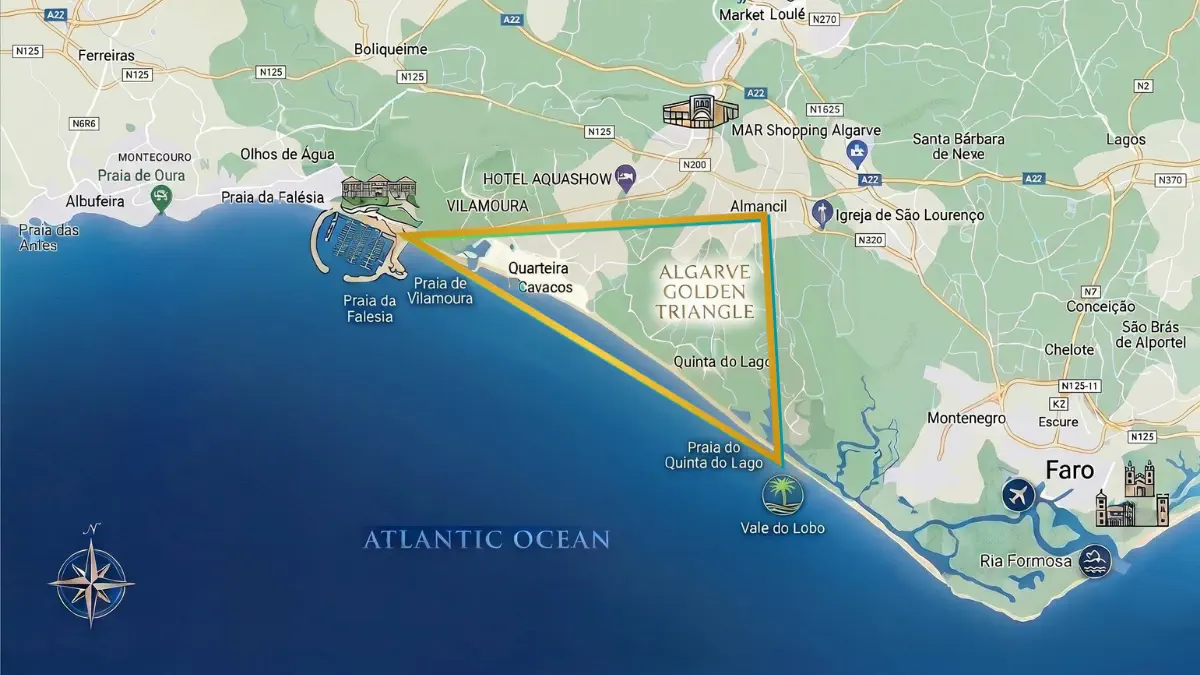
The Algarve Goldn Triangle

Vilamoura: A Golfing Institution

Vilamoura marks the western point of the Triangle and is, by volume, the most significant golf destination in the Algarve. Five courses operate here, from a half-century-old classic to a modern European Tour venue.

The Vilamoura Old Course, designed by Frank Pennink and opened in 1969, has hosted the Portuguese Open multiple times and remains the most satisfying round in the region — a mature, pine-lined layout that demands course management over raw power. It is the course that built Vilamoura’s reputation, and it has not lost the thread.
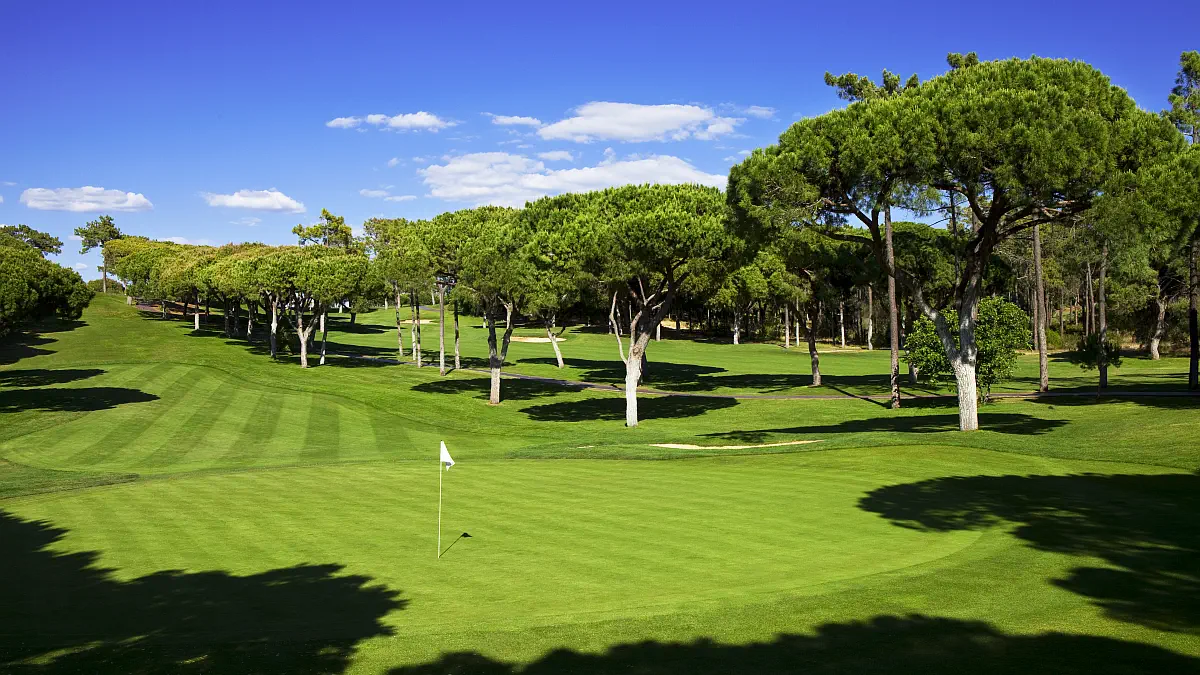
Vilamoura Old Course pine-lined fairway, Algarve, Portugal

Pinhal, Laguna and Millennium courses complete the portfolio. Pinhal for its pine-forest atmosphere, Laguna for its water-threaded layout, Millennium for a more open, links-influenced feel — together offering enough variety to anchor a full week’s golf without leaving the resort.

Vale do Lobo: The Resort That Started It All

Vale do Lobo marks the southern point of the Triangle. Established in 1962 — a full decade before Quinta do Lago — it was the first luxury resort development in the Algarve, and remains the largest in Portugal.  Sir Henry Cotton’s original layout was eventually divided into the two courses that exist today. (Vale do Lobo)

The Vale do Lobo Royal is the reason most golfers make the trip. Rocky Roquemore’s redesign in the late 1990s gave it the coherence it now carries through eighteen holes. The par-3 16th — over 200 metres from the back tee, full carry over a clifftop ravine — is one of the most photographed holes in European golf. It is not merely a spectacle. It is a hard hole played honestly.
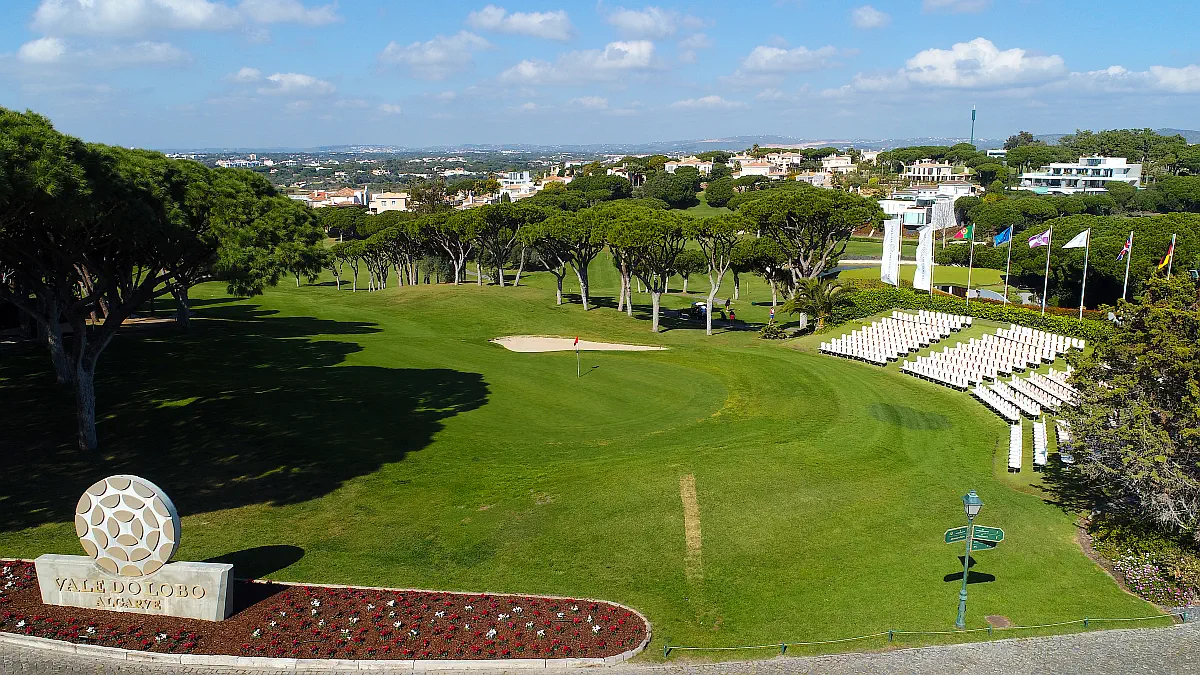
Vale do Lobo Royal Course

The Vale do Lobo Ocean is the secondary option. Several back-nine holes skirt the beach, lending a genuine links-like quality — best treated as a complement to the Royal rather than a substitute.

Almancil: The Northern Corner — and the Most Storied Ground

The northern corner of the Triangle sits around Almancil, and it is here that the Algarve’s most prestigious golfing addresses are concentrated. The Quinta do Lago estate runs three courses; San Lorenzo operates alongside them as its own entity.

Quinta do Lago was founded in 1972 on land that had belonged to a single family for three centuries. It hosted its first Portuguese Open in 1976 — played in military tents, without permanent facilities — and has carried that competitive pedigree ever since. The Quinta do Lago South is the flagship: a mature, precisely conditioned par 72 that has hosted the Portuguese Open eight times, including Colin Montgomerie’s record 24-under-par victory in 1989 — his first European Tour win, by eleven strokes. (DP World Tour)
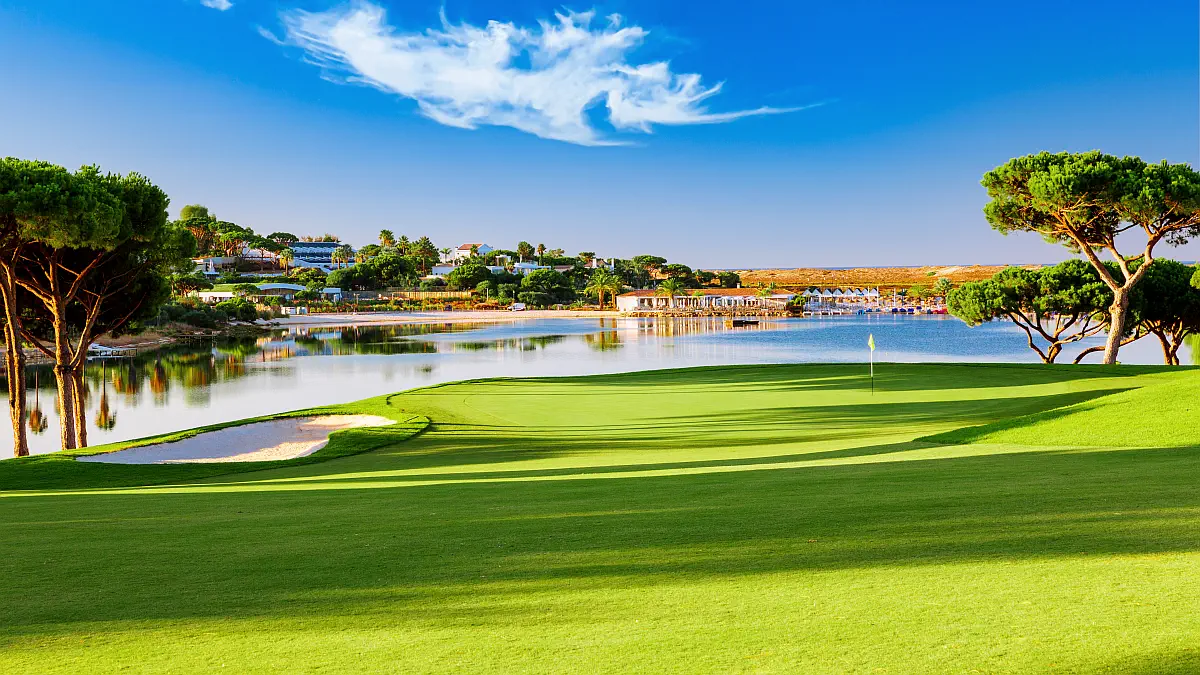
Quinta do Lago South, 16th hole

The Quinta do Lago North was redesigned in 2014 in a €9 million project overseen by Paul McGinley and Beau Welling — longer and more exposed, with modern bunkering that tests club selection as much as ball-striking. Laranjal, opened in 2009 on a former orange grove, is quieter in atmosphere; golfers who return to Quinta do Lago more than once often find themselves drawn back to it.

Beyond the courses, Quinta do Lago is effectively self-contained — restaurants, a spa, a lake, and the Ria Formosa Natural Park on the doorstep. For those travelling with non-golfers, no other address in the Triangle makes the same case.

San Lorenzo rounds out the corner. Opened in 1988 and designed by Joseph Lee and Rocky Roquemore, its routing winds through pine forest and alongside the Ria Formosa lagoons — herons, white storks and purple gallinules visible from the fairways. For golfers who want a course that sits within a landscape rather than imposed upon it, San Lorenzo offers something the others do not.
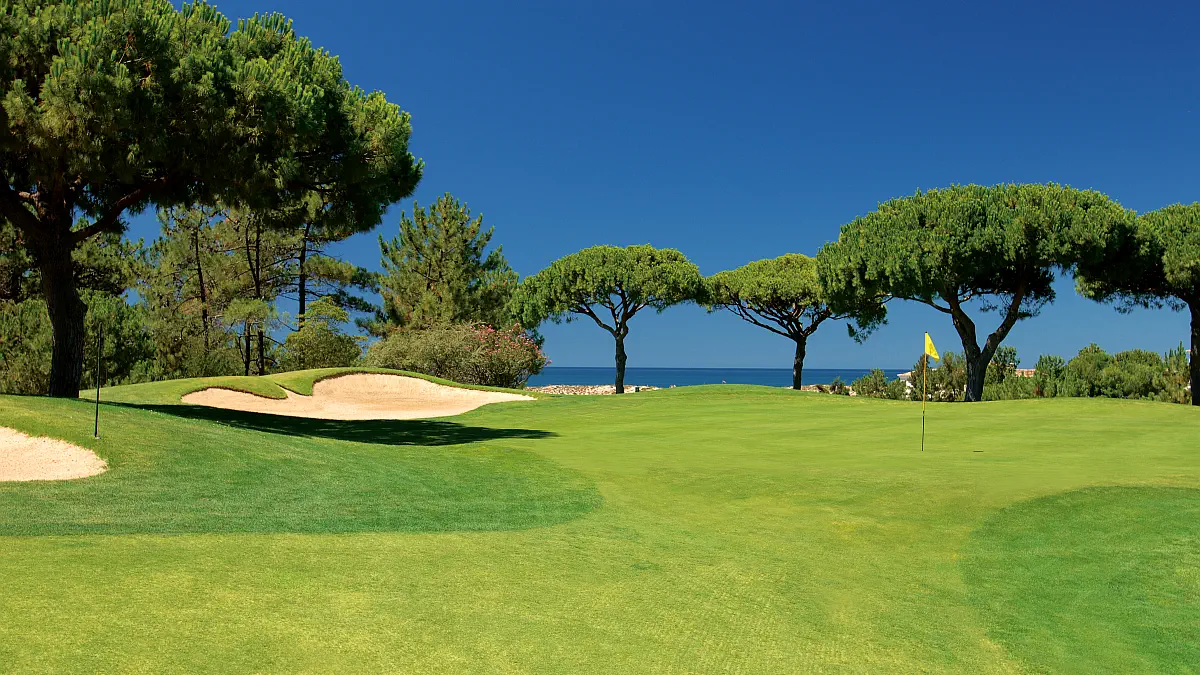
San Lorenzo Golf Course holes bordering the Ria Formosa lagoons

Who Should Play Here — and What the Marketing Doesn’t Say

Green fees in the Golden Triangle sit at the upper end of the Algarve’s range, and the courses earn them. Championship conditioning, histories built through decades of competitive golf, and settings that cannot be replicated elsewhere on the peninsula — this is what the premium delivers, and for a golfer playing at this level, it is consistently there.

What the marketing tends to compress is the variety within the Triangle. These courses are not interchangeable. Quinta do Lago South, San Lorenzo and the Vilamoura Old Course are the prestige rounds — the names you come back from and mention first. The Victoria and the North are serious tests on their own terms. Laranjal and the Pinhal are the surprises that convert first-timers into regulars. The Ocean and Laguna offer a different texture to the week — best played alongside the headline courses rather than instead of them.

The Golden Triangle is, in the end, a collection of courses that ask to be taken seriously — and that reward golfers who do. History, challenge, and a setting worth the flight, with an evening in Vilamoura or Almancil that matches the quality of the day.

For those planning a trip, browse our Algarve golf holidays to see what Tee Times Golf Holidays — Europe’s Best Golf Tour Operator 2025 — can put together.



Vote for Tee Times