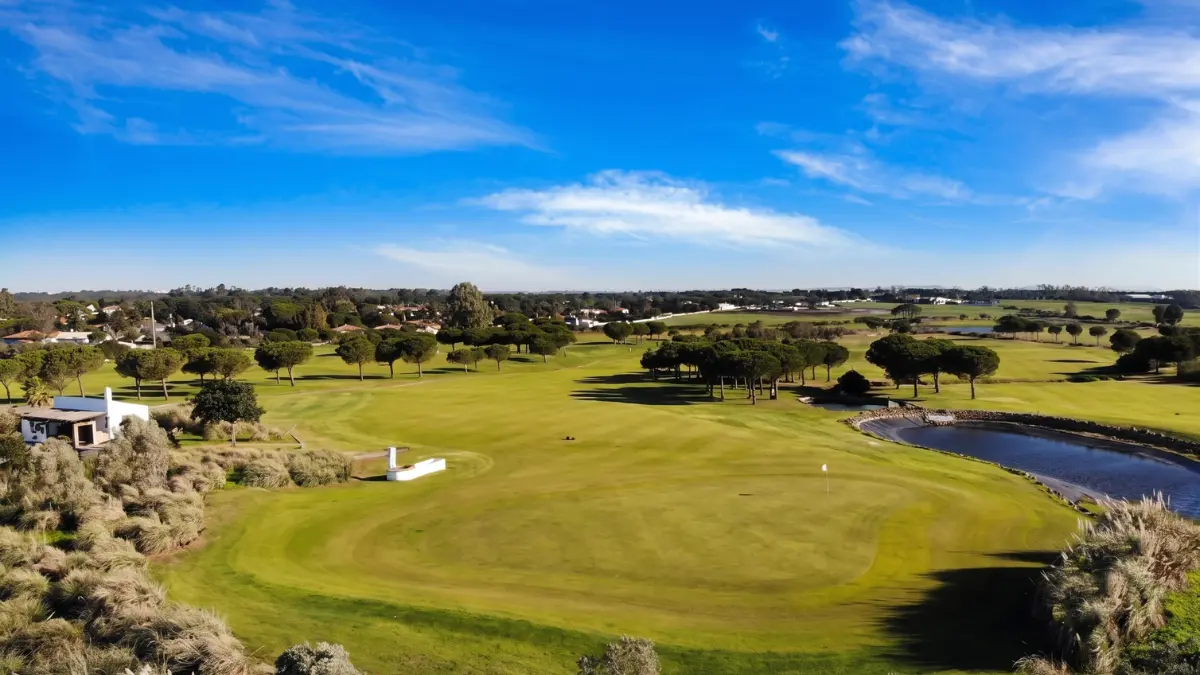
HotelPlanner Tour’s Grand Final Returns to Alcanada

Mallorca’s north coast turns into the season’s biggest stage this autumn. Club de Golf Alcanada, tucked beside the lighthouse at Port d’Alcúdia, will host the Rolex Grand Final supported by The R&A from Thursday 29 October to Sunday 1 November 2026 — the HotelPlanner Tour’s season-ending showpiece, and the sixth time this coastal test has closed out the Road to Mallorca.

A Course That Keeps Getting Asked Back

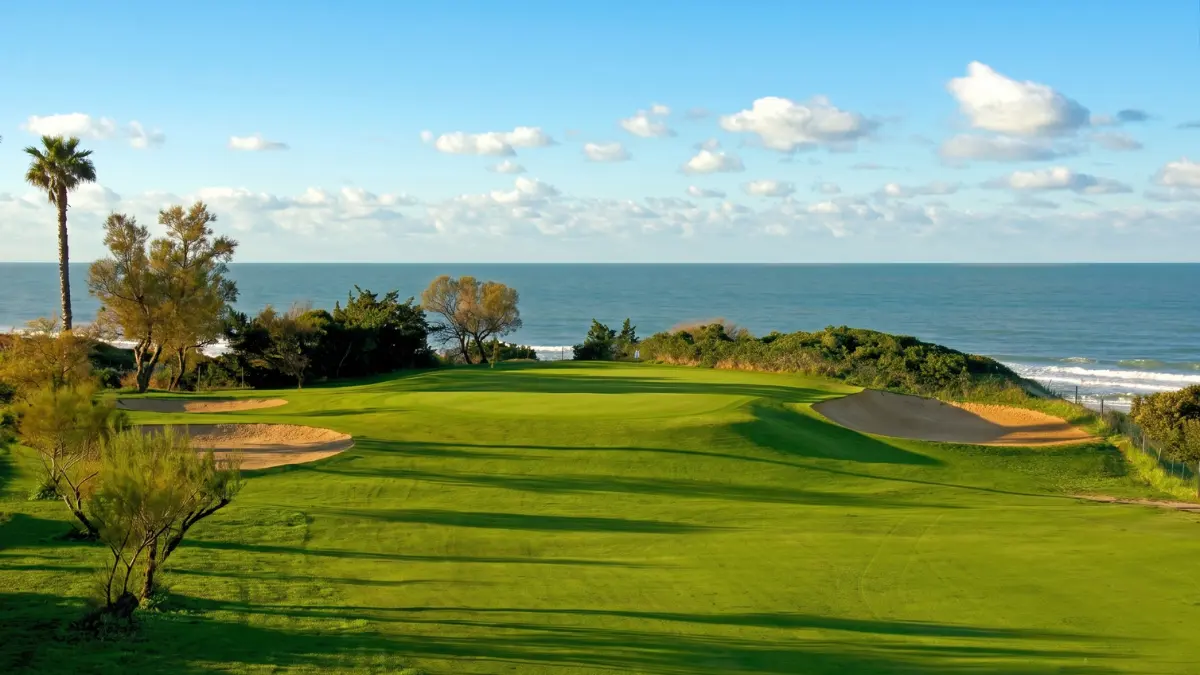
Coastal hole at Club de Golf Alcanada with the lighthouse visible, Mallorca

Designed by Robert Trent Jones Jr and opened in 2003, Alcanada is Mallorca’s only genuinely coastal course, its par-72 layout sloping down toward the Mediterranean and that lighthouse on the tiny island just offshore. This will be the fifth consecutive year — and sixth overall — that the club has staged the Grand Final, a run matched by very few venues on the European golf calendar. (Club de Golf Alcanada)

Fifteen Cards on the Line

Mediterranean view from Club de Golf Alcanada near Port d'Alcúdia, Mallorca

The Grand Final caps a 28-tournament Road to Mallorca season spanning 19 countries and three continents, with a total prize fund of €9 million. This week alone carries €500,000 and 4,000 Race to Mallorca points — double the usual event — as the leading players chase one of 15 DP World Tour cards, down from 20 the year before. Graduates qualify for the DP World Tour’s Earnings Assurance Programme, guaranteeing $150,000 in minimum earnings for 2027, with the top five also receiving the John Jacobs Bursary. (Golf Business News)

Last Year’s Fairytale Sets the Bar

HotelPlanner Tour Grand Final trophy presentation, Mallorca

The 2025 edition is a hard act to follow. James Morrison, sitting 36th in the rankings and reportedly considering retirement, carded four rounds in the 60s and low 70s to win outright and reclaim his DP World Tour card twelve months after losing it. JC Ritchie, meanwhile, topped the season-long rankings on the back of three wins. Whoever tops the leaderboard at Alcanada this November will be writing the next chapter in a Grand Final story that rarely disappoints. (HotelPlanner Tour)

Alcanada’s coastal winds and exposed greens have a habit of deciding careers, and this year’s field will feel every gust of it. For golfers who’d rather play the course than just watch it on a leaderboard, Mallorca’s fairways are open well beyond tournament week. Browse our Balearic Islands golf holidays and put yourself on the same coastline.

Vote for Tee Times

Real Novo Sancti Petri’s Summer Card Fills Up Fast

Fourteen Tournaments, Two Courses, One Very Busy Cádiz Clubhouse.

There is a particular kind of energy at a Spanish golf club in high summer, when the heat sits heavy over the fairways by mid-morning and the clubhouse fills anyway. Chiclana de la Frontera does not slow down for it. Real Novo Sancti Petri’s 2026 tournament calendar runs fourteen fixtures across July and August, a mix of national circuits, charity fundraisers and corporate golf days that keeps both courses busy well past the point most clubs start thinking about siesta.

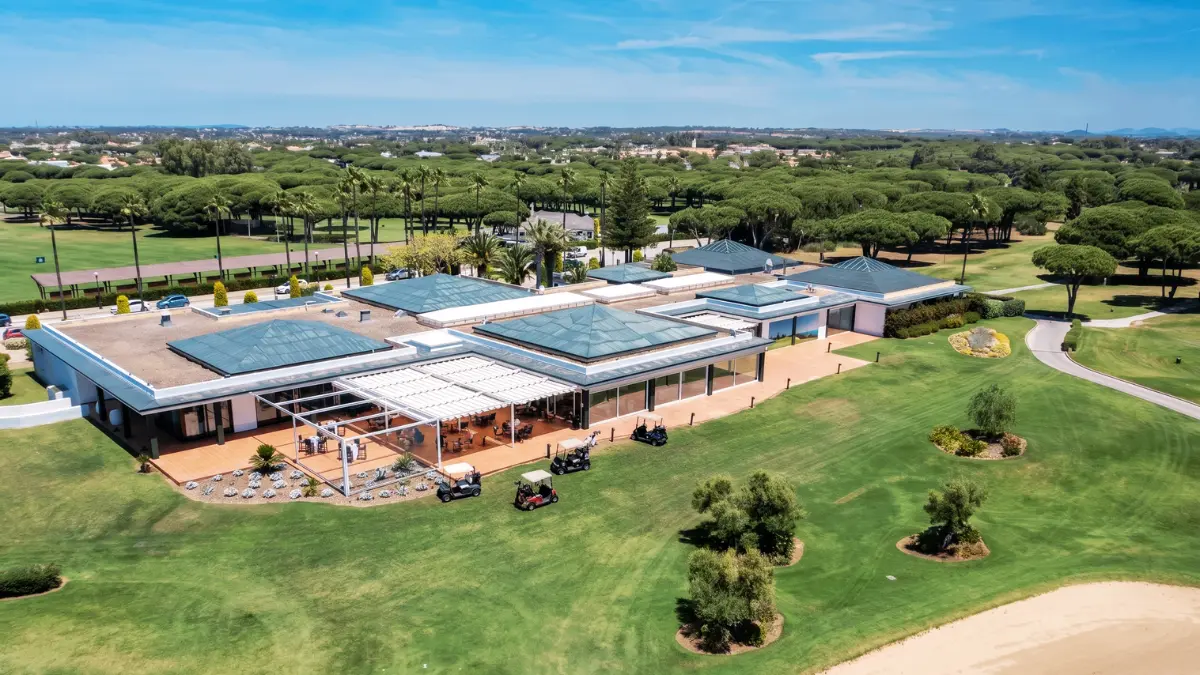
Clubhouse terrace at Real Novo Sancti Petri during the summer tournament season

Fourteen Fixtures, Two Courses

Three events open the run in July, with eleven more following through August, split across the club’s two Seve Ballesteros-designed layouts, Pines & Sea and Centre. It is a demanding schedule for any club to host back to back through the hottest months of the year, and a fair indication of how central golf remains to summer life on this stretch of the Costa de la Luz. There is something rather satisfying about a fixture list this dense — proof that a club’s popularity holds even when the mercury does not cooperate. (Real Novo Sancti Petri)

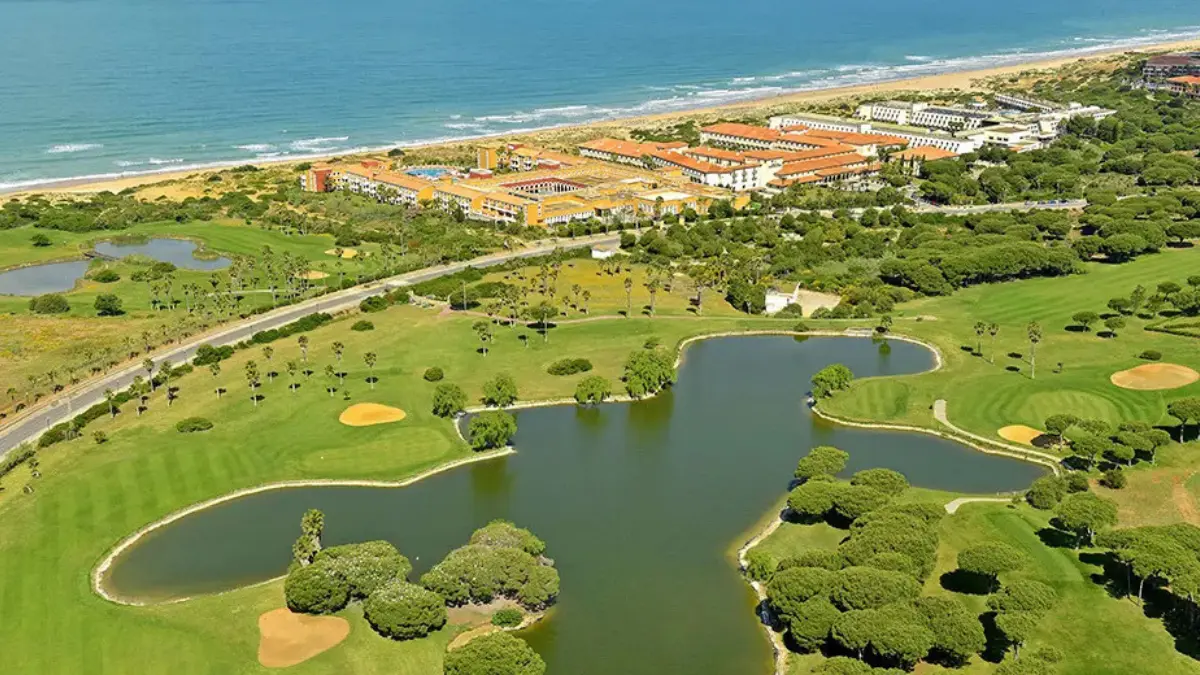
Aerial Shot of Real Novo Sancti Petri

Corporate Names on the Card

Several of the August dates carry a brand’s name rather than a sponsor’s logo tucked in the corner — Coca-Cola, Nestlé, Ferrer Wines and Royal Bliss all host days, alongside hospitality fixtures for Coco Novo Beach Club, Le Club and Golf Divino. It is a reminder that in Spain, a golf day often doubles as a client lunch with rather better scenery — introductions made on the first tee, deals half-settled by the turn, the real business conducted somewhere around the eighteenth green with a cold drink in hand. (Real Novo Sancti Petri)

Real Novo Sancti Petri Drone Shot

Charity Fixtures and National Circuits

Unicaja and the Spanish Association Against Cancer (AECC) both run fundraising tournaments within the calendar, sitting alongside stops on established national amateur circuits. For a club of this size, hosting both charity golf and competitive circuit events in the same eight-week window says as much about its course conditioning as its popularity — greens and fairways do not survive that kind of traffic on reputation alone.

Real Novo Sancti Petri Gol and Waves

Chiclana as a Base

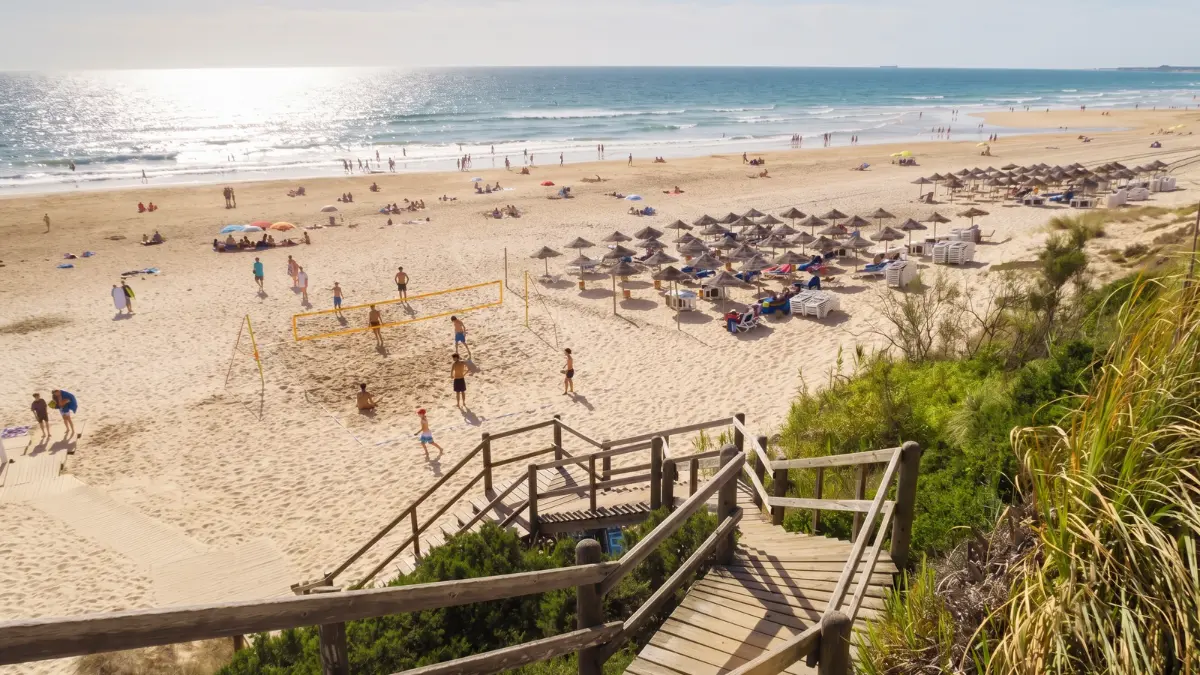
The town itself rewards anyone building a trip around the calendar rather than just a tee time. La Barrosa beach sits a short drive from the clubhouse, its stretch of pale sand backed by pine forest rather than concrete, and the seafood along the seafront is the kind that makes an evening feel earned after eighteen holes in the heat. Chiclana has long operated in the shadow of its more famous Cádiz neighbours — Sancti Petri’s tournament calendar this summer is a definite argument for giving it rather more attention.

La Barrosa beach near Chiclana de la Frontera, close to Real Novo Sancti Petri

Booking a Round Around It

Registration for each fixture runs through TeeOne, with places allocated by order of booking rather than by invitation. Anyone travelling to the Costa de la Luz this summer who fancies a competitive round rather than a quiet one would do well to check the calendar before finalising dates — a packed tournament sheet also means a genuinely busy, sociable clubhouse most evenings.

A summer this full says everything about where Cádiz golf currently stands. Browse our Cádiz golf holidays and build a trip around it.

The Canary Islands: Spain’s Year-Round Golfing Secret

No peak season to dodge, no off-season to wait out, just the same welcoming weather window, twelve months running.

Most Spanish golf destinations are a trade-off. Book the Costa del Sol in August and you’re playing through serious heat; book it in January and you’re reaching for a jacket between holes. The whole calendar becomes a negotiation.

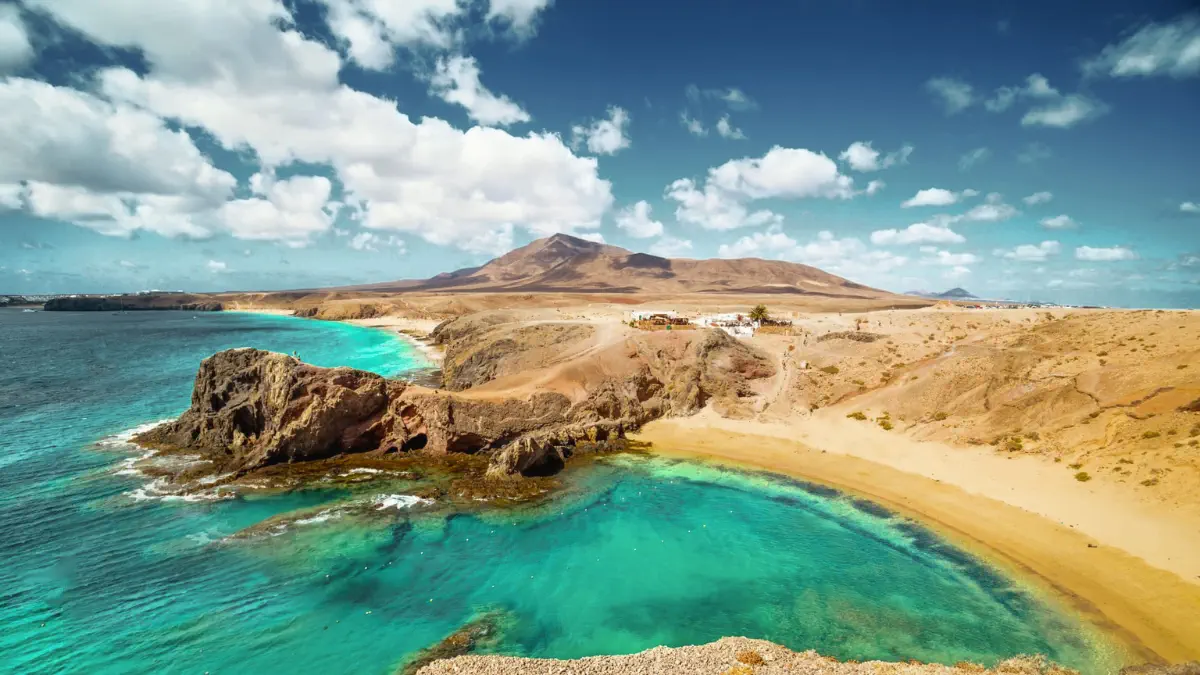
Emerald coastline in the Canary Islands

Four hundred kilometres south, off the coast of Morocco, the Canary Islands quietly opt out of that negotiation altogether. The trade winds and the cool Canary Current flatten the curve almost entirely — there’s no brutal summer to avoid and no proper winter to wait out, just a single, remarkably narrow temperature band that holds steady whichever month the flight happens to land in.

The numbers that matter

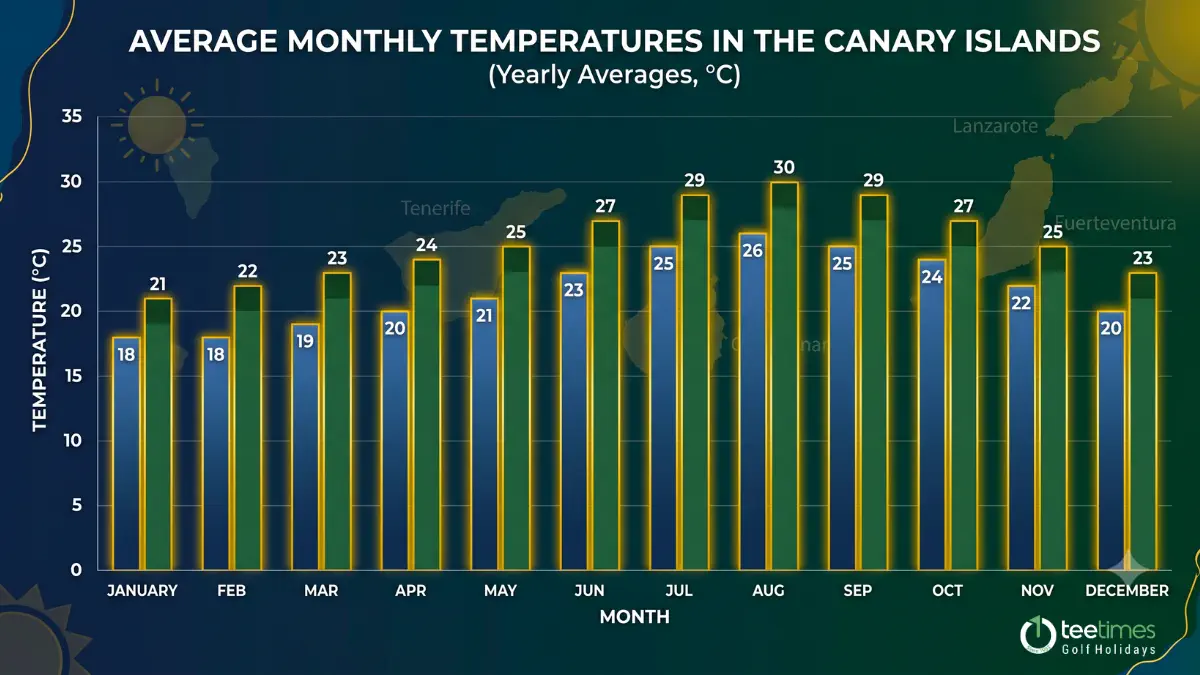
This isn’t a marginal difference, and it isn’t only a winter story. Tenerife and Gran Canaria sit around 20-21°C through January, mild enough that the sea stays swimmable through the coldest part of the year. Roll forward to August — peak Mediterranean heat everywhere else in Spain — and the islands only climb to around 24-29°C, kept in check by the same trade winds and current.

Monthly averages of the Canary Islands

Compare that with Málaga, where January highs average 14-17°C and August highs push past 33°C. The mainland Costas swing through a 20-degree range across the year. The Canaries barely move 7 or 8 degrees in either direction. For a golfer, that means the calendar stops being a variable — any month works, and the round at hand never has to be rescheduled around the heat or the cold. (Guide to Canary Islands)

Volcanic architecture, not Mediterranean cliché

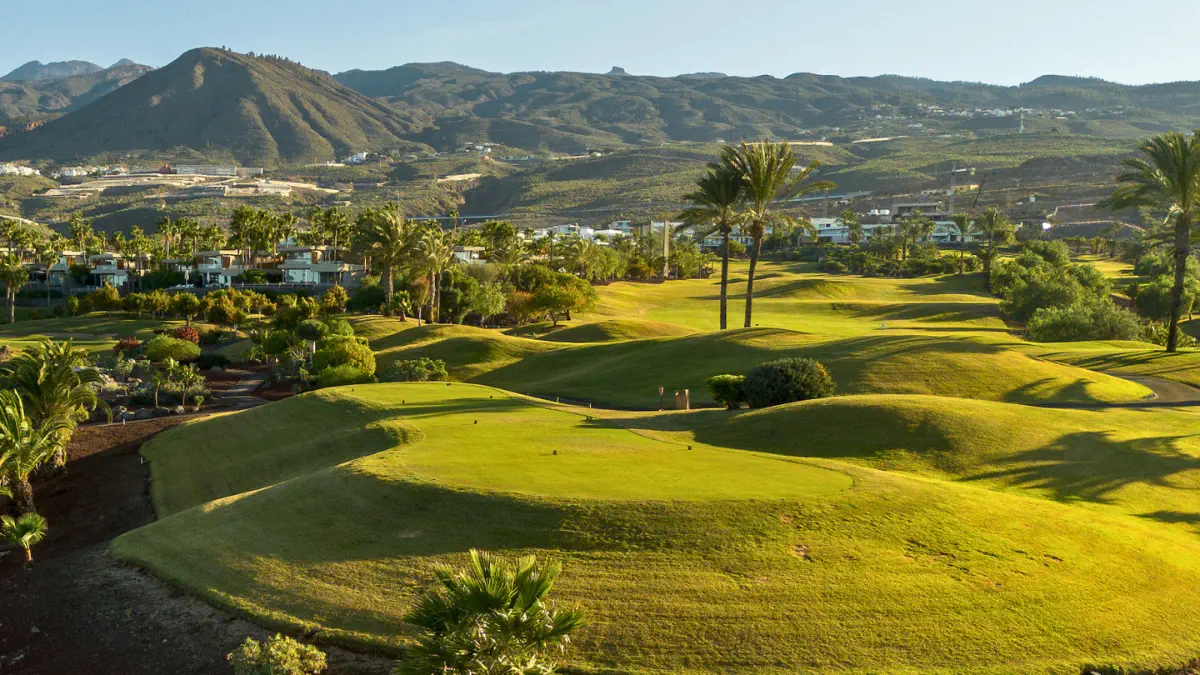
The other thing the Canaries offer that the mainland Costas can’t replicate is the terrain itself. These are young volcanic islands, and the courses built on them tend to show it. Abama in Tenerife sits carved into a ravine on the island’s northwest tip, framed by banana plantations and the silhouette of Mount Teide — Spain’s highest peak — looming behind it.

Abama Golf Course Tenerife

Anfi Tauro in Gran Canaria threads through a steep inland valley with elevation changes that owe more to Arizona desert golf than anything coastal Spain usually offers.Lanzarote takes this further still. The Lanzarote Golf Course and the more compact Costa Teguise sit on an island whose entire landscape was shaped by eruptions as recent as the 1730s — black volcanic soil, lunar ridgelines, a backdrop that looks nothing like the rest of Spain because, geologically, it isn’t.

Tenerife: altitude and ocean in the same round

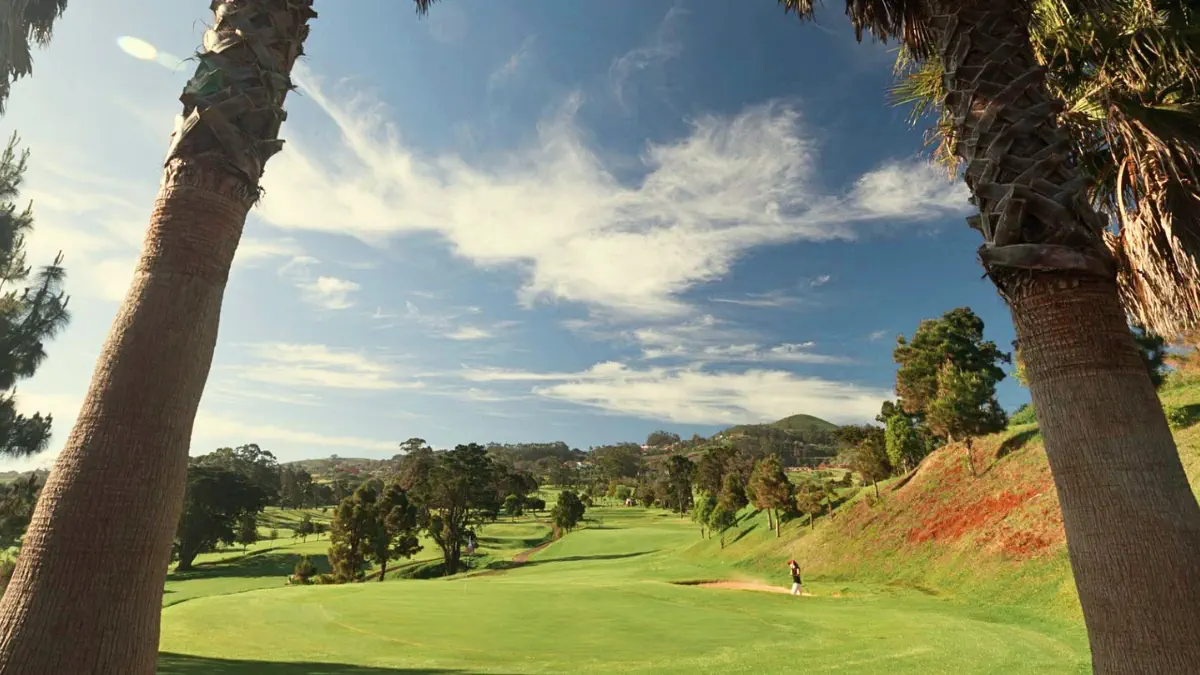
Tenerife’s golf benefits from genuine variety, helped along by an island that rises from sea level to nearly 3,700 metres inside a few dozen kilometres. Real Club de Tenerife, founded in the early twentieth century, remains one of the most established clubs in the Canaries.

Real Golf Club in Tenerife

Further south, Amarilla Golf & Country Club plays along volcanic cliffs above the Atlantic, with several holes running close enough to the water that the swing thoughts compete with the view.

Gran Canaria: a continent in miniature

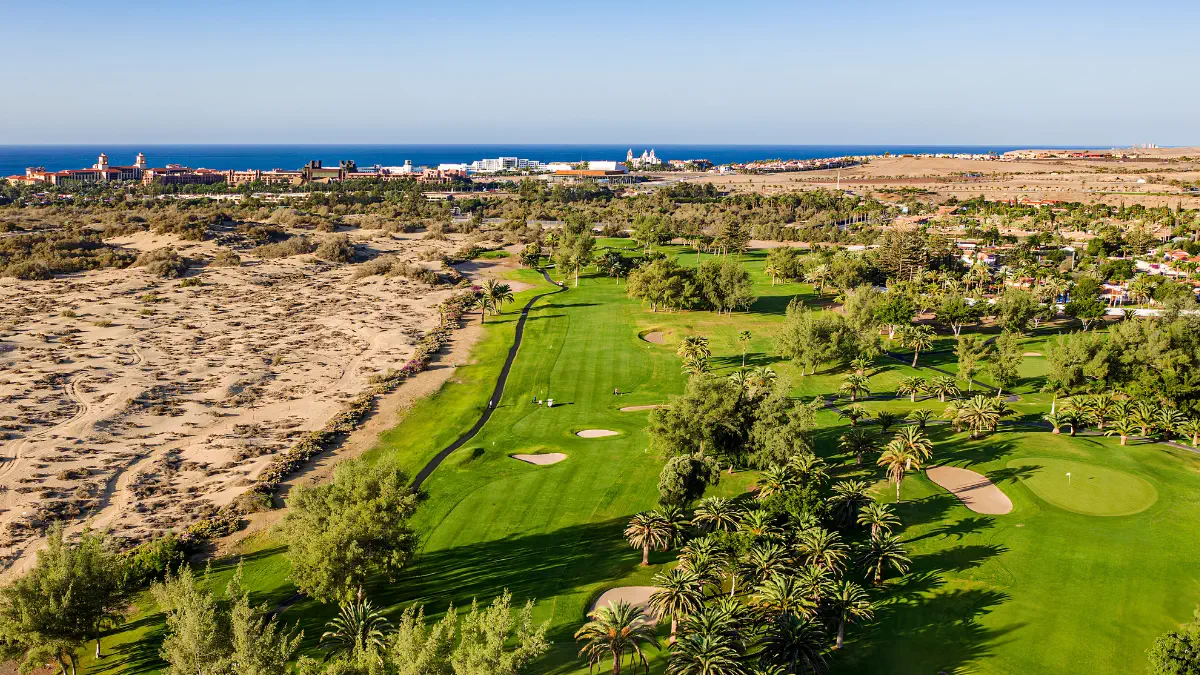
Gran Canaria is sometimes called a miniature continent, and the golf reflects that range. Maspalomas Golf Course runs along the edge of the island’s famous dunes — a links-style test with the Sahara-like sand dunes as a backdrop rather than the usual sea grass.

Maspalomas Golf Course, Sand Dunes aand Green Fairways

Real Club de Golf Las Palmas, meanwhile, is the oldest golf club in Spain, founded in 1891, and sits inside the rim of an extinct volcanic crater at Bandama — a setting that’s difficult to find anywhere else in Europe.

Where the rounds end the day

None of this matters much if the rest of the trip doesn’t hold up, and it does. The southern resorts on Tenerife and Gran Canaria are built for exactly this kind of break — proper hotels, good spas, and restaurants that take the local seafood seriously. Canarian cuisine has its own identity, distinct from the mainland: papas arrugadas with mojo sauce, fresh vieja parrotfish, and a wine scene shaped by volcanic soil that produces something genuinely unusual in the glass.

The golf, the climate, and the landscape all point the same direction: this is a destination that doesn’t ask the golfer to pick a season. There’s no “best time to go” caveat to factor in, no shoulder months to chase — just a calendar that stays playable from the first week of January to the last week of December.

Browse Canary Islands golf holidays and pick the month that suits you — not the one the weather dictates.


Vote for Tee Times